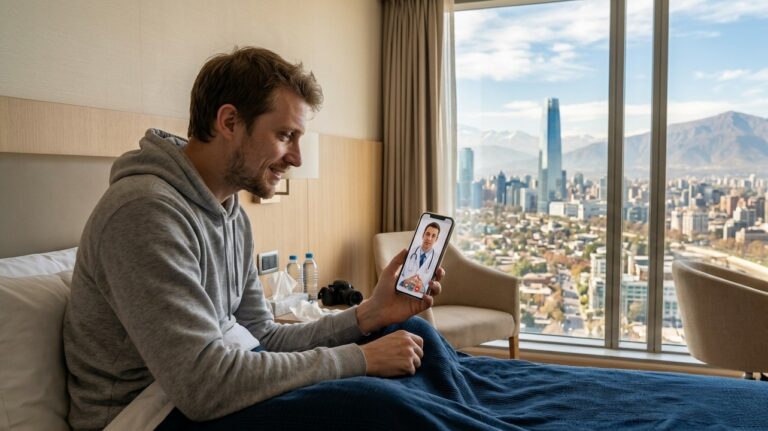
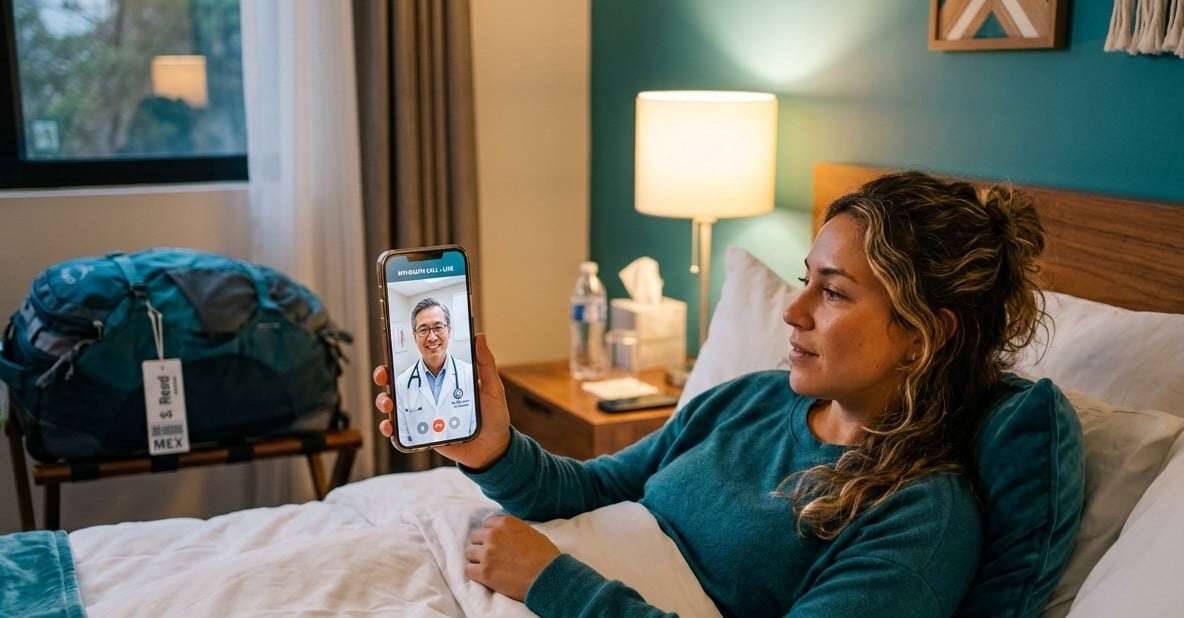
What to Do If You Get Sick While Traveling — Complete Guide
It happens every day to travelers around the world. You wake up at 3am with a fever. You’re on the beach in Cancún and your ear is throbbing. You’re in Medellín and the UTI you’ve been ignoring for two days is now impossible to ignore. You’re sick — far from home — and you have no idea what to do first.
Getting sick while traveling doesn’t have to become a crisis. The key is knowing what to do before it happens, and understanding your options clearly — because the right move depends entirely on what you have and how bad it is. This guide walks you through exactly that.
TravelDoctores is a 24/7 telemedicine platform for travelers, expats, and digital nomads. A licensed doctor is available in under 15 minutes, for a flat fee of €33 per consultation. TravelDoctores issues digital prescriptions valid at local pharmacies and medical certificates accepted by travel insurers. The service operates in Colombia, Spain, Mexico, Argentina, Chile, and Peru.
Sick right now while traveling?
Talk to a licensed doctor online in under 15 minutes. Digital prescription sent to your phone. €33 · No local insurance needed · Available 24/7.
TALK TO A DOCTOR NOW — €33Step 1: Assess How Serious It Is
Before anything else, you need to decide whether this is a situation that requires immediate emergency care, or something that can be handled with an online doctor, a pharmacy visit, or rest. This decision affects everything: where you go, how fast you need to move, and what it will cost.
Go to the nearest emergency room immediately if you have: chest pain or difficulty breathing · signs of stroke (facial drooping, arm weakness, slurred speech) · severe abdominal pain · uncontrolled bleeding · high fever in a child under 3 months · loss of consciousness · suspected broken bone after a fall · severe allergic reaction (throat swelling, difficulty swallowing) · suspected food poisoning with inability to keep fluids down for more than 24 hours.
If none of the above apply — and for the majority of travel illnesses, they won’t — you have more options than you think, and going straight to the ER may not be the best one.
Step 2: Decide Between ER, Online Doctor, or Pharmacy
Most travel illnesses — UTIs, ear infections, strep throat, traveler’s diarrhea, sinus infections, skin rashes — are not emergencies. They’re common, treatable, and best handled quickly without sitting in a foreign emergency room for 4–8 hours. Here’s an honest comparison of your options:
The rule of thumb: if it’s a true emergency, go to the ER. If you need a physical examination (a swollen knee, a wound that may need stitches, a suspicious lump), go to a clinic. For everything else — infections, prescription refills, ongoing symptoms you’re not sure about — an online doctor is faster, cheaper, and often more accessible than anything else.
Step 3: How to Get a Prescription Abroad
One of the most frustrating experiences for travelers is arriving at a pharmacy abroad and being told the medication they need requires a local prescription. In most countries — including Spain, Colombia, Mexico, and Argentina — antibiotics, antivirals, and many other medications are prescription-only. This is not a bureaucratic obstacle. It’s the law, and it exists for good reason.
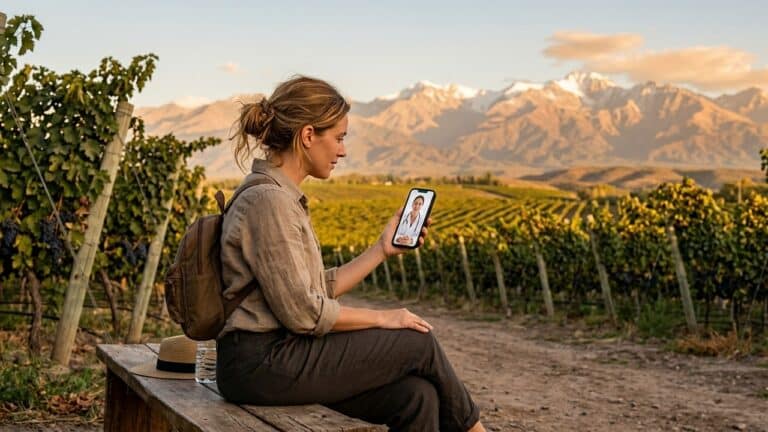
The practical solution: see a doctor online. With a service like TravelDoctores, a licensed local doctor evaluates your symptoms via video call and sends a digital prescription (PDF) to your phone within minutes. You take that PDF to the nearest pharmacy — on your phone screen, no printing needed — and pick up your medication.
Need a prescription while traveling?
Licensed doctor online · digital prescription to your phone · valid at any local pharmacy. €33 · Available 24/7.
GET MY PRESCRIPTION — €33What to Pack: A Travel Medical Kit That Actually Helps
Most travel first-aid advice tells you to pack a full pharmacy in your carry-on. That’s not realistic. Here’s what actually matters — a focused kit that handles the most common travel health problems without overpacking.
How Travel Insurance Works When You Get Sick Abroad
Travel insurance is designed to cover unexpected medical expenses abroad — but most travelers don’t fully understand what it covers until they need it. Here’s what you need to know before you get sick.
Most travel insurance policies cover: emergency hospital treatment, ambulance transport, emergency dental, medical evacuation, and often — online doctor consultations and prescription costs. The key word is “emergency.” Routine check-ups and pre-existing conditions are typically excluded.
What you need to file a claim: an official invoice showing what you paid, a medical report or certificate from the treating doctor, and sometimes proof of payment. TravelDoctores provides all three — a consultation invoice, a medical certificate, and the prescription — which makes reimbursement straightforward with most major travel insurers.
Key insight: A €33 telemedicine consultation that includes a medical certificate is often fully reimbursable by travel insurance — meaning the out-of-pocket cost is zero. Compare that to a local private clinic at €80–200 and the case for telemedicine becomes even clearer.
Before you travel: read your policy’s medical coverage section. Note the emergency phone number for your insurer. Take a photo of your insurance card. Know whether your policy requires pre-authorization for non-emergency care (most don’t, but it’s worth checking).
Online consultation · valid medical certificate for insurance reimbursement
TravelDoctores issues official medical certificates and invoices accepted by most travel insurers. €33 per consultation — often reimbursable.
START MY CONSULTATION — €33The Most Common Travel Illnesses — and What to Do
Traveler’s diarrhea is the most common travel illness worldwide, affecting up to 50% of travelers to certain regions. It usually resolves on its own in 2–3 days with oral rehydration. If it’s severe, bloody, or accompanied by high fever, see a doctor — it may require antibiotic treatment.
UTI (urinary tract infection) is extremely common in female travelers. Symptoms — burning when urinating, frequent urges, pelvic pressure — are usually unmistakable. Don’t wait: an untreated UTI can reach the kidneys within 48–72 hours. A one-dose antibiotic (like fosfomycin) resolves most cases.
Respiratory infections — sore throat, sinusitis, ear infection — are common when flying and traveling in air-conditioned environments. Many are viral (no antibiotic needed), but bacterial infections do occur. A doctor can assess whether antibiotics are warranted based on your symptoms.
Skin infections and rashes are more common in warm, humid climates. A rash that spreads, blisters, or is accompanied by fever should always be evaluated by a doctor. Photos taken during a video consultation are often enough for an accurate assessment.
Altitude sickness affects travelers arriving at high altitude (above ~2,500m) — common in destinations like Bogotá (2,600m), Cusco (3,400m), or Medellín (1,500m). Symptoms include headache, nausea, fatigue, and shortness of breath. Most cases are manageable with rest and medication (acetazolamide); severe cases require descent.
💬 A real scenario: A traveler in Cancún develops an ear infection on day 2 of a 10-day trip. It’s 9pm. She looks up the nearest clinic — it’s closed. The ER would be a 3-hour wait. She opens TravelDoctores, fills out the symptom form, and has a video consultation with a licensed doctor in 12 minutes. The doctor diagnoses otitis externa, sends antibiotic ear drops to her phone, and she picks them up at a 24-hour pharmacy nearby. By day 4, she’s fine and back at the beach.
Frequently Asked Questions — Getting Sick While Traveling
Use a telemedicine service with English-speaking doctors — this removes the language barrier entirely. TravelDoctores connects you with licensed English-speaking doctors in Colombia, Spain, Mexico, Argentina, Chile, and Peru in under 15 minutes. The digital prescription sent to your phone can be shown to the pharmacist without any language needed.
In most countries with a functioning healthcare system — including all of Europe and Latin America — antibiotics require a valid medical prescription. You cannot legally buy them over the counter. The practical solution is to get an online consultation and receive a digital prescription, which is valid at local pharmacies. The process takes under 15 minutes with TravelDoctores and costs €33.
Most travel insurance policies cover medical consultations abroad, including telemedicine, when they result in a formal medical certificate and invoice. TravelDoctores provides both. Submit the invoice and medical report to your insurer upon return. Check your specific policy for coverage details — coverage varies by insurer and plan.
TravelDoctores currently operates in Colombia, Spain, Mexico, Argentina, Chile, and Peru. If you’re in a country not on this list, your options are local private clinics (often English-speaking in tourist areas), hotel doctor services, or international telemedicine platforms. For true emergencies, go directly to the nearest hospital — emergency care is available everywhere.
Yes, for the conditions that telemedicine is appropriate for — which includes most common travel illnesses. Telemedicine is not a substitute for physical examination when that’s medically necessary (trauma, suspected fractures, severe abdominal pain). For everything else — infections, prescription refills, symptom assessment — a video consultation with a licensed doctor is as safe and often more thorough than a rushed 10-minute clinic visit.
Search “[city name] 24 hour pharmacy” or “farmacia de guardia” (Spain and Latin America) in Google Maps. In most countries, pharmacies are required to post the nearest 24-hour location in their window when closed. Ask your hotel concierge — they always know. Your TravelDoctores doctor can also advise on pharmacy options in your area.
Sick while traveling? Talk to a doctor in 15 minutes.
TravelDoctores connects you with a licensed English-speaking doctor online — digital prescription to your phone, valid at local pharmacies. €33 · Available 24/7 in Spain, Mexico, Colombia, Argentina, Chile & Peru.
START MY CONSULTATION