Sick in Torres del Paine? Medical Help for Trekkers
There is no doctor inside Torres del Paine National Park. Refugio staff provide basic first aid only. The nearest medical center is in Puerto Natales — approximately 110km from the park entrance (Laguna Amarga), which is 2–3 hours by bus or 1.5 hours by car. For emergencies inside the park, CONAF (park authority) coordinates evacuation by vehicle or helicopter.
You’re three days into the W Trek. You’ve passed Mirador Las Torres, crossed the valley to the Grey Glacier, and now you’re at Refugio Paine Grande with a fever you can’t shake, or a blister that’s gone from painful to hot, swollen, and probably infected. Or it’s 2am and the stomach cramps won’t stop.
This is the part that adventure travel blogs tend to skip: what actually happens when something goes medically wrong in one of the world’s most remote trekking destinations. Puerto Natales is 110km away. The nearest hospital is there. You’d have to exit the park, get on a bus or arrange transport, and lose two or more days of your trip — or your entire trip if it’s serious.
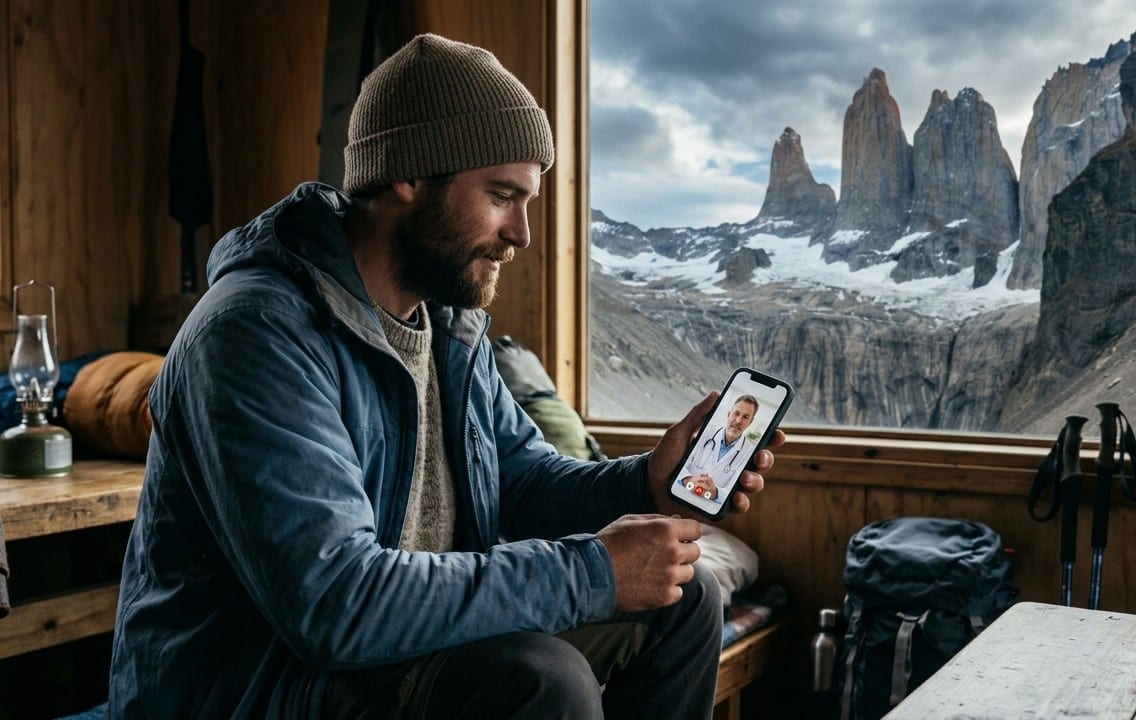
A licensed doctor evaluating your case by video call from your refugio can make the critical call: this is manageable here with the right treatment, or you need to get out tonight. That distinction — made properly, based on real clinical assessment — can save your trek or your health. Visit our online doctor in Torres del Paine page for more details.
Something’s wrong on the trek — talk to a doctor now.
Licensed doctor by video call · from any refugio with WiFi · assess severity · prescription or evacuation advice · 24/7 · €33.
SEE A DOCTOR NOW — €33Health risks on the Torres del Paine trek
The W Trek (4–5 days) and the Circuit (8–10 days) expose trekkers to a specific set of medical risks that differ significantly from city travel. These aren’t rare worst-case scenarios — they’re the issues that come up regularly among the hundreds of trekkers who pass through the park every week.
Infected blister? Fever? Stomach that won’t settle?
A doctor tells you whether to treat and continue — or exit the park tonight. Video call from your refugio · €33.
GET MEDICAL ADVICE — €33What a doctor can do from your refugio by video call
Remote medicine has real limitations — a doctor can’t examine you physically, can’t run blood tests, and can’t stitch a wound. But a proper clinical assessment by video, with structured questions and visual observation, resolves a surprisingly high percentage of trek medical situations:
- Assess whether an infected wound needs antibiotics: the distinction between local inflammation (normal healing) and cellulitis (needs treatment) can often be made visually. The doctor looks at the spreading redness, asks about fever, and prescribes if needed.
- Decide whether a GI illness needs rest or evacuation: vomiting and diarrhea in a healthy adult who can still hold down small amounts of fluid is very different from a trekker who hasn’t kept anything down for 24 hours and is showing signs of dehydration. The doctor assesses which situation you’re in.
- Evaluate respiratory symptoms: Is this a cold that’s manageable with rest and ibuprofen? Or is there a developing chest infection that needs antibiotics to continue safely? This clinical distinction determines whether you can push on to the next refugio tomorrow.
- Guide ankle injury decision-making: “Can I walk on it tomorrow?” The doctor assesses fracture risk based on mechanism, location of pain, and ability to bear weight, and advises on strapping, anti-inflammatories, and the realistic continuation decision.
- Prescribe for UTI, skin infections, respiratory: If medication is needed, the prescription is sent by WhatsApp. Another trekker, a ranger, or the refugio staff may have the antibiotic in their kit — or it may wait until Puerto Natales if the clinical picture allows.
When to stop the consultation and call for evacuation immediately
These situations require evacuation — contact CONAF rangers immediately and do not wait for morning:
• Suspected fracture (cannot bear weight, bone deformity)
• Chest pain or difficulty breathing beyond normal exertion
• Core temperature that won’t recover after warming — severe hypothermia
• Signs of serious head injury: confusion, loss of consciousness, unequal pupils
• Severe allergic reaction (throat swelling, hives spreading rapidly, difficulty breathing)
• Vomiting blood or blood in stool with fever
CONAF emergency contact: inform the nearest ranger station. The park has helicopter evacuation capability for life-threatening emergencies. For non-life-threatening but serious situations, vehicle evacuation to Puerto Natales is coordinated through park administration.
Connecting with a doctor from inside the park
Pack smart before you leave Puerto Natales: Bring a basic first aid kit including ibuprofen, paracetamol, blister care (moleskin, second skin pads), oral rehydration salts, and an elastic ankle bandage. A broad-spectrum antibiotic like amoxicillin-clavulanate, prescribed before you start the trek by a TravelDoctores doctor, can cover skin infections and respiratory infections if something develops mid-route — ask during a pre-trek consultation.
💬 Real case: An American trekker on day 4 of the Circuit noticed his blister had turned red beyond the edges, felt hot, and had a small amount of yellow discharge. His temperature was 37.8°C — low-grade but there. He used the WiFi at Refugio Dickson to start a TravelDoctores consultation at 7pm. The doctor looked at photos of the wound and assessed it as early cellulitis — not an emergency, but needed antibiotics within 24 hours. Another trekker in the dining room happened to have amoxicillin-clavulanate in her kit and offered one tablet as a first dose. The next morning, the trekker adjusted his exit point and reached Puerto Natales that afternoon. The infection resolved in 4 days. He kept three of four planned days on the trail.
Without the consultation, he would have either continued and risked a serious infection or abandoned the trek entirely — neither decision was necessary.
Frequently asked questions — sick in Torres del Paine
Most main refugios operated by Fantastico Sur and Vertice Patagonia have WiFi, though coverage and speed vary significantly. Refugio Chileno (closest to Mirador Las Torres), Central, Torre Sur, Grey, and Paine Grande generally have the best connectivity. Free camping sites do not have WiFi. If you’re planning to rely on connectivity, use the refugio dining room or reception area rather than the dormitories, where signal is usually weakest. Download the TravelDoctores app or save the website before leaving Puerto Natales in case connectivity is limited inside the park.
Essential: blister care (moleskin, blister plasters, second skin pads), ibuprofen and paracetamol, elastic ankle bandage, antiseptic wipes and small dressing pads, oral rehydration sachets, and any personal prescription medications with extra supply. Consider bringing a broad-spectrum antibiotic (amoxicillin-clavulanate covers skin and respiratory) — a pre-trek TravelDoctores consultation can prescribe this before you leave Puerto Natales. Sun protection (SPF 50+) matters even on cloudy Patagonian days due to Southern Hemisphere UV levels.
No. Refugio staff are trained in basic first aid but are not medical professionals. CONAF (park administration) rangers also carry first aid supplies and coordinate emergency evacuations but are not doctors. The nearest doctor is in Puerto Natales, at the Hospital de Puerto Natales. For serious medical emergencies, CONAF coordinates vehicle evacuation or — for life-threatening situations — helicopter evacuation through the Chilean Emergency System.
Yes. If you need to exit the park and the doctor determines antibiotics are needed, the prescription PDF is sent to your phone during the consultation. When you reach Puerto Natales, there are pharmacies in town where you can present the digital prescription to pick up the medication. This avoids the need to go directly to the hospital for common conditions like skin infections, UTIs, or respiratory infections where the diagnosis is clear from the clinical assessment.
For emergencies inside Torres del Paine, inform the nearest CONAF ranger station immediately. Rangers have radio communication with park administration and can coordinate vehicle or helicopter evacuation. The CONAF administration center is at the park entrance (Laguna Amarga) and at Lago Pehoé. For life-threatening emergencies, Chile’s emergency number is 131 (ambulance/SAMU) — mobile coverage inside the park is limited, but the CONAF radio network is the reliable emergency channel. Each refugio also has emergency communication protocols.
Sick in Torres del Paine? Get a doctor’s assessment from your refugio.
Licensed Chilean doctor · video call · decides if you continue the trek or exit the park.
€33 · Available 24/7 · Works wherever there’s WiFi.