
See a Doctor in Brazil as a Tourist: 2026-2027 Guide

If you get sick in Brazil, call 192 for a medical emergency, and for anything that is not an emergency you can see a licensed doctor by video in English, Portuguese or Spanish. That is the short answer, and the rest of this guide explains the details most travellers only learn after they need them: how the public and private systems work for visitors, how to get medicines at a Brazilian pharmacy, which health risks to know about and how to reach a doctor from wherever you are, from Rio to the Amazon.
The short version: emergencies go to SAMU (192), a public hospital or a 24-hour UPA unit. Everything else, from infections and stomach problems to allergies, refills and travel vaccines, can be handled by an online doctor in Brazil who speaks your language. TravelDoctores has licensed doctors across the country, and a consultation costs €33.
What should I do if I get sick in Brazil?
First decide whether it is an emergency. Chest pain, difficulty breathing, severe bleeding, loss of consciousness, a serious injury or a very high fever that does not come down are emergencies, and in those cases you call 192 (SAMU) for an ambulance, 193 for the fire brigade or 190 for the police. All three numbers are free from any phone. If you can move, go to the nearest public hospital or to a 24-hour UPA (Unidade de Pronto Atendimento), which attends urgent cases at any hour.
Most problems travellers have are not emergencies: a urinary infection, diarrhoea after a street-food lunch, an ear or sinus infection, conjunctivitis, a rash, an allergic reaction, or simply running out of a regular medicine. For those, waiting hours in an emergency room is the slowest option. A video consultation lets you describe symptoms to a doctor in your language and, when it is appropriate, receive a prescription you can take to a pharmacy. You can see the full list of what we treat on our what we treat page, and how the service works on how an online doctor works.
Can foreigners use Brazil’s public health system?
Brazil has a universal public health system called SUS, and public hospitals and UPA units attend emergencies, including visitors from abroad. For routine or non-urgent care, public services can mean queues, and the experience changes a lot between a large city and a small town. For that reason most visitors rely on travel insurance or private care for anything that is not urgent, and keep the public system as the safety net for real emergencies.
Do I need travel insurance for Brazil?
Yes, I would not travel without it. Private hospitals in Brazil often ask for payment or a guarantee before treating you, and a serious problem in a remote area can mean medical evacuation. Before you leave, check that your policy covers private hospitals, repatriation and the activities you plan to do. If you pay out of pocket, keep every invoice and the medical report, because you will need them to claim. Our guide on travel insurance and online doctors abroad explains how a video consultation fits with an insurance claim.
Can I see an English-speaking doctor in Brazil online?
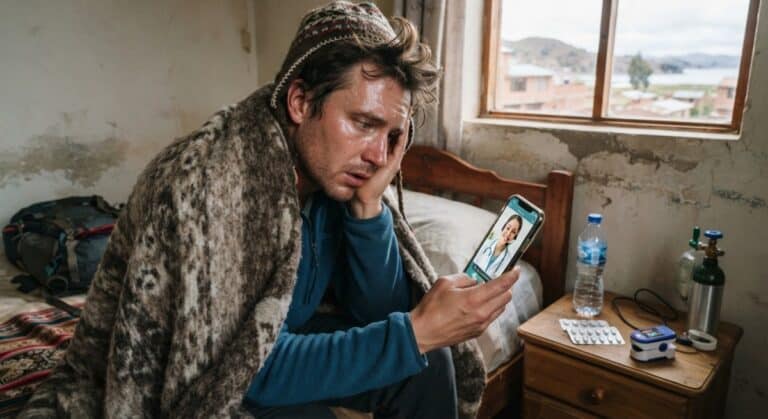
Yes. TravelDoctores works with doctors registered with Brazil’s medical council (CRM) who consult in English, Portuguese and Spanish, and who attend patients across the whole country, around the clock. At night, availability can be reduced and it may take longer for a doctor to accept your case. Because the consultation is by video, you only need a phone or laptop and an internet connection, whether you are in Copacabana, Florianópolis, Salvador, São Paulo or a lodge in the Pantanal. The process is simple: you fill in a short form on the English-speaking doctor in Brazil page, a doctor accepts your case, you pay online (€33) and you connect by video call.
The Spanish option matters more than people think. Every southern summer, huge numbers of visitors from Argentina, Chile and other Spanish-speaking countries travel to Brazil, and explaining symptoms in a second language is hard when you are unwell. Our doctors can also consult in Portuguese, which helps if you live in Brazil or need to explain your situation to a pharmacist or hospital afterwards.
Need a doctor in Brazil now?
Video consultation in English, Portuguese or Spanish. €33, from wherever you are.
Can I get a prescription in Brazil as a foreigner?
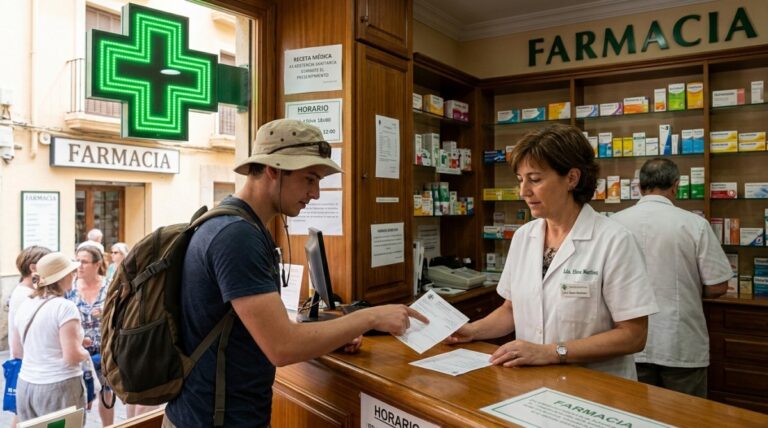
Pharmacies (farmácias) are everywhere in Brazilian cities and many stay open late or 24 hours, but they expect a prescription from a doctor registered in Brazil, and antibiotics cannot be bought without one. A prescription from your home country is normally not enough. When it is clinically appropriate, our doctors in Brazil, who are registered with the CRM and can prescribe, issue a prescription under Brazilian rules after a video consultation, and you take it to the pharmacy. Whether a particular medicine can be prescribed is always the doctor’s decision, and controlled medicines may not be possible. If you are looking for a specific medicine, tell the doctor during the consultation and they will tell you honestly what is feasible.
Which health risks should I know before travelling to Brazil?
Yellow fever. The CDC recommends the vaccine for most travellers to Brazil, including trips to Rio de Janeiro and São Paulo, and it is generally not recommended for visits limited to Fortaleza and Recife. You should be vaccinated at least ten days before you travel. If you are not sure whether your route needs it, read our guide on yellow fever vaccine prescriptions with an online doctor and check the CDC travel health page for Brazil.
Dengue and other mosquito-borne diseases. Dengue is present in much of the country and rises with the hot, rainy months of the southern summer. Chikungunya, Zika and Oropouche also circulate in some regions. There is no specific treatment for dengue, so prevention matters: use repellent, cover up at dusk and see a doctor early if you develop a sudden fever with headache and muscle pain, because early care reduces the risk of complications. Malaria is mostly a concern in rural parts of the Amazon region, not in the main tourist cities.
Travellers’ diarrhoea, sun and heat. Stomach problems are the most common reason visitors seek care. Drink bottled or filtered water, be careful with raw foods and ice, and use sun protection. If you already have symptoms, our page on travellers’ diarrhoea treatment online explains when it can be treated at home and when you should see a doctor.
When is the best time to be careful and who travels then?
Brazil’s busiest travel season runs from December to March, with New Year’s Eve in Rio and Carnival in February, when heat, crowds and mosquitoes make health problems more likely. It is also the peak for Spanish-speaking visitors, and in July there is a second wave of domestic and international holidays. If you plan to travel in those months, book your travel insurance early, check your vaccines two months ahead and save the contact of an online doctor before you leave.
Resumo em português: se você precisa de um médico no Brasil, a TravelDoctores oferece teleconsulta por vídeo com médicos inscritos no CRM, em português, inglês e espanhol, em todo o país, a qualquer hora (à noite a espera pode ser maior). A consulta custa €33. Em caso de emergência, ligue 192 (SAMU).
Resumen en español: si necesitás un médico en Brasil, TravelDoctores ofrece videoconsulta con médicos inscritos en el CRM, en español, portugués e inglés, en todo el país y a cualquier hora (de noche la espera puede ser mayor). La consulta cuesta €33. En una emergencia llamá al 192 (SAMU).
If you are travelling to Brazil, save this page and our WhatsApp number before you go. A small problem becomes a big one when you do not know who to ask, and the best moment to find a doctor is before you need one.
Dr. RossiPhysician and founder, TravelDoctores · Colegiado nº 080851873
Frequently asked questions
If it is an emergency, call SAMU on 192 for an ambulance, or go to the nearest public hospital or 24-hour UPA unit. For everything that is not an emergency, such as infections, stomach problems, allergies or a prescription, you can see a doctor by video consultation with TravelDoctores in English, Portuguese or Spanish.
The main emergency numbers are 192 for SAMU (ambulance and medical emergencies), 193 for the fire brigade and 190 for the police. All three are free to call from any phone.
Public hospitals and 24-hour UPA units attend emergencies, including visitors. For routine care, waiting times can be long and the experience varies by city, so most travellers rely on travel insurance or private care for anything that is not urgent.
It is strongly recommended. Private hospitals often ask for payment or a guarantee upfront, so keep your invoices and medical report to claim afterwards. Check that your policy covers private hospitals and medical evacuation, especially if you plan to visit remote areas.
Yes. TravelDoctores has doctors registered in Brazil (CRM) who consult in English, Portuguese and Spanish and attend patients across the country, around the clock. At night it may take longer for a doctor to accept your case. You fill in a short form, a doctor accepts it and you connect by video. The consultation costs €33.
Pharmacies in Brazil expect a prescription from a doctor registered in Brazil, and antibiotics cannot be bought without one. Our doctors in Brazil are registered with the CRM and can prescribe, and when it is clinically appropriate they issue a prescription under Brazilian rules after a video consultation. Controlled medicines are the doctor’s decision and may not be possible.
The CDC recommends the yellow fever vaccine for most travellers to Brazil, including trips to Rio de Janeiro and São Paulo, and it is generally not recommended for trips only to Fortaleza and Recife. Get it at least 10 days before you travel and ask a doctor about your itinerary.
Dengue spreads with the hot and rainy months of the southern summer, so risk is higher between December and May. Use repellent, wear light long sleeves at dusk and see a doctor early if you have a sudden fever with headache and muscle pain.
Yes. Our doctors in Brazil consult in Spanish as well as Portuguese and English, which is useful for the many visitors from Argentina, Chile and other Spanish-speaking countries who travel to Brazil every summer.
A TravelDoctores video consultation costs €33, whichever city you are in. The price is paid online before the consultation starts.
Talk to a doctor in Brazil
Video consultation · English, Portuguese and Spanish · €33