
Ozempic, Wegovy and Mounjaro Online: How Asynchronous Telemedicine Is Changing GLP-1 Prescriptions

Asynchronous Telemedicine and GLP-1 Treatments: Getting Ozempic, Wegovy and Mounjaro Prescribed Online
Getting access to GLP-1 weight loss medications like Ozempic, Wegovy, and Mounjaro has historically required in-person appointments, long waiting lists, and navigating a specialist referral system that many patients simply give up on. Asynchronous telemedicine is changing that entirely.
This article explains what asynchronous telemedicine is, how it works for GLP-1 prescriptions, what the clinical evidence says about these medications, and where this service is heading — including plans for Spain, Mexico, Argentina, Colombia, Chile, and Peru.
What is asynchronous telemedicine?
Most people think of telemedicine as a video call with a doctor — you’re both online at the same time, you speak, the doctor evaluates you, and you get a prescription. That model is called synchronous telemedicine, and it is already widely used.
Asynchronous telemedicine removes the requirement for simultaneous availability. Instead, the patient completes a detailed, structured clinical questionnaire at whatever time suits them — from their phone, at home, on a lunch break. That completed form is then reviewed by a licensed physician, who evaluates the clinical information, makes a medical decision, and issues a prescription or provides a clinical response — without needing to be online at the same moment.
Why this matters more than it might seem
The traditional barrier to accessing treatments like Ozempic or Wegovy is not usually clinical — it is logistical. You need to get a GP appointment, wait days or weeks, explain your weight history, get referred to an endocrinologist or obesity specialist, wait months, get evaluated again, and finally receive a prescription. Patients who genuinely qualify for GLP-1 treatment frequently abandon this process before completing it.
Asynchronous telemedicine compresses that entire pathway into a single structured form, reviewed by a physician who specializes in exactly this evaluation. The clinical standard doesn’t change. The friction does.
GLP-1 medications: Ozempic, Wegovy and Mounjaro explained
GLP-1 receptor agonists are a class of medications that work by mimicking glucagon-like peptide-1, a hormone naturally produced in the gut in response to food. They reduce appetite, slow gastric emptying, increase feelings of fullness, and improve blood glucose regulation. The clinical results — particularly for weight loss — have been among the most significant in obesity medicine in decades.
It’s worth clarifying a common point of confusion. Ozempic and Wegovy contain the same active molecule — semaglutide — but are approved for different indications. Ozempic is approved for type 2 diabetes management, with weight loss as a significant secondary effect. Wegovy is the same molecule at a higher dose (2.4mg), specifically approved for chronic weight management in adults with obesity or overweight with at least one weight-related comorbidity.
Mounjaro (tirzepatide) is a dual agonist — it activates both the GLP-1 and GIP receptors simultaneously, producing the largest weight loss effects currently seen in approved pharmacotherapy. Clinical trials showed average reductions of up to 22% of body weight, a figure that was previously only achievable with bariatric surgery.
These medications require proper medical supervision
GLP-1 agonists are not supplements. They are prescription medications with real contraindications, dose titration requirements, and potential side effects — most commonly gastrointestinal: nausea, vomiting, and diarrhea, particularly during the initial dose escalation phase. They are contraindicated in patients with a personal or family history of medullary thyroid carcinoma or multiple endocrine neoplasia syndrome type 2, among other conditions.
The value of asynchronous telemedicine is precisely that it applies real clinical evaluation — not just a checkbox — to determine eligibility. Patients who do not meet the criteria are not prescribed these medications.
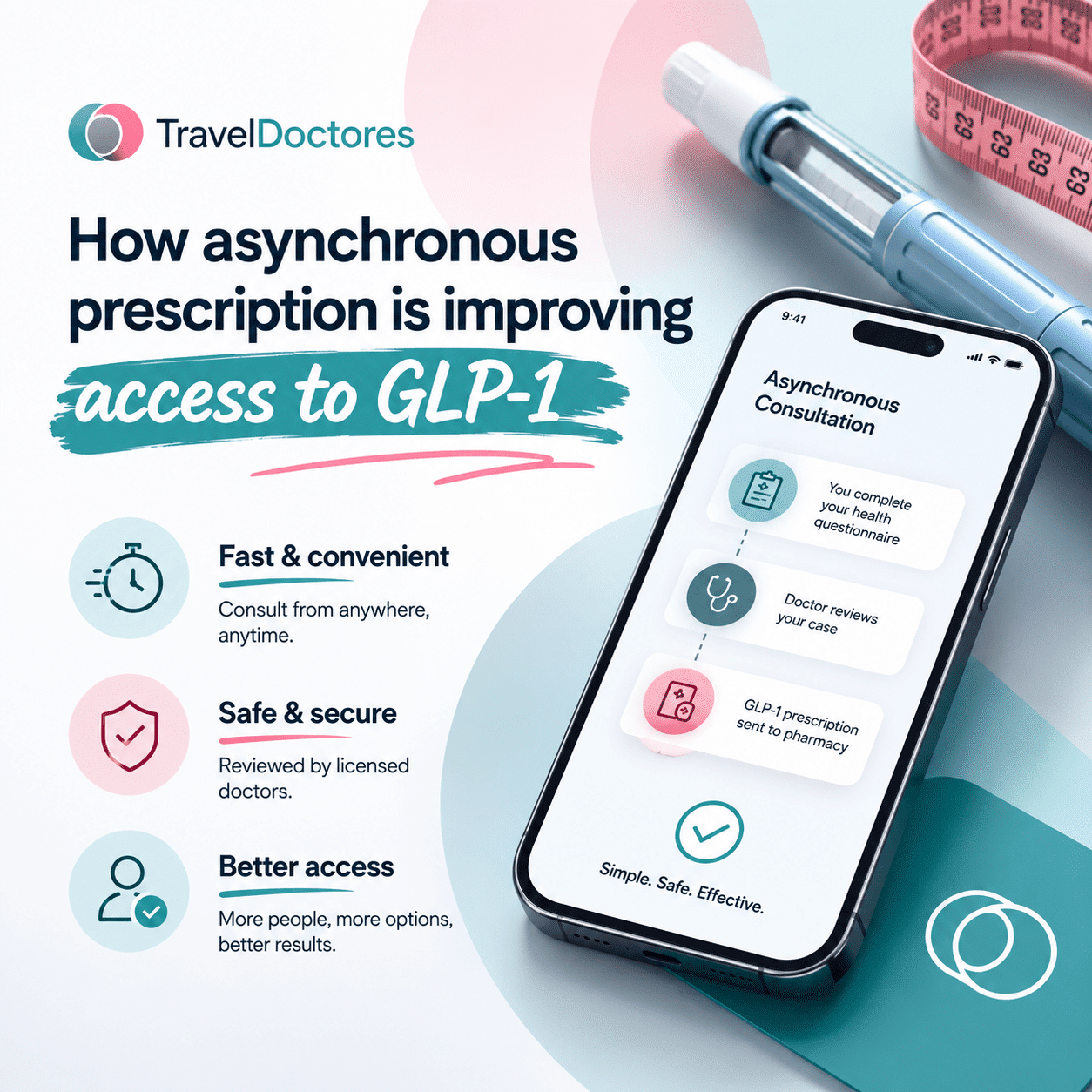
How asynchronous prescription works for GLP-1
The asynchronous consultation process for GLP-1 medications is designed to replicate the clinical rigour of an in-person evaluation — without requiring you to be available at a specific time or travel to a clinic.
Complete the clinical form
Fill out a structured questionnaire covering your weight history, BMI, current medications, relevant diagnoses, and contraindications. Takes approximately 10–15 minutes.
Physician review
A licensed family medicine specialist reviews your complete clinical profile, applies GLP-1 eligibility criteria, and makes a formal medical decision — typically within a few hours.
Prescription and follow-up plan
If clinically appropriate, your prescription is issued digitally along with a dose titration schedule, monitoring guidance, and access to follow-up consultations.
A key feature of the asynchronous model for GLP-1 is that it doesn’t end at the prescription. Effective GLP-1 treatment requires dose escalation over weeks, monitoring for side effects, and regular reassessment of response. The asynchronous platform supports ongoing follow-up — patients can submit progress updates, questions, and side effect reports between scheduled reviews, without needing to book a new appointment each time.
What the clinical form actually captures
The asynchronous intake form for GLP-1 evaluation is not a simple checkbox. It captures current weight and height, calculated BMI, weight history and previous interventions, presence of comorbidities (type 2 diabetes, hypertension, dyslipidaemia, sleep apnea, cardiovascular disease), current medications and potential interactions, personal and family history of thyroid conditions, history of pancreatitis, mental health history relevant to eating behaviour, and realistic expectations and lifestyle context. This information allows the reviewing physician to apply the same eligibility criteria used in clinical trials and specialist practice — remotely and asynchronously.
Join the waitlist for Spain, Mexico, Argentina, Colombia, Chile and Peru — be the first to access when it launches in your country.
Join the waitlist →Who qualifies for GLP-1 treatment?
Clinical eligibility for GLP-1 receptor agonists for weight management is based on objective, measurable criteria. The current evidence-based thresholds, consistent across major guidelines, are as follows:
| Criterion | Standard threshold | Notes |
|---|---|---|
| BMI ≥ 30 | Obesity — primary indication | GLP-1 indicated as first-line pharmacotherapy alongside lifestyle intervention |
| BMI ≥ 27 + comorbidity | Overweight with complication | Comorbidities include hypertension, type 2 diabetes, dyslipidaemia, sleep apnea, cardiovascular disease |
| Previous interventions | Evidence of prior lifestyle attempts | Diet, physical activity modifications — not necessarily successful, but attempted |
| No contraindications | MTC history, MEN2, active pancreatitis, pregnancy | Full contraindication list reviewed during clinical assessment |
Patients with type 2 diabetes who are already prescribed Ozempic through their endocrinologist are not the primary population for this service. The focus is on patients with obesity or overweight and comorbidities who have not been able to access specialist care — either because of waiting lists, cost, geography, or the sheer friction of the referral process.
- BMI of 30 or above, regardless of comorbidities
- BMI of 27 or above with at least one weight-related health condition
- Adults aged 18 and over
- No personal or family history of medullary thyroid carcinoma
- No history of multiple endocrine neoplasia syndrome type 2
- Not currently pregnant or breastfeeding
- No history of acute pancreatitis in the past 12 months
Where this service is available
TravelDoctores is currently building out asynchronous GLP-1 prescription services across six markets where the demand for accessible, affordable weight management care is highest and where telemedicine regulation supports this model. Each market has its own regulatory framework, medication availability, and prescription requirements — all of which are factored into the rollout.
Regulatory compliance is non-negotiable in each market. Asynchronous prescription models are only deployed in countries where the legal framework explicitly supports remote prescribing by licensed physicians. In markets where regulation is still evolving, TravelDoctores is monitoring developments closely and building capacity ahead of formal launches.
Is it safe to get a GLP-1 prescription online?
This is the most important question — and the honest answer is: it depends entirely on who is doing the prescribing and how. The safety of an asynchronous GLP-1 prescription is a function of the clinical process, not the channel.
A rigorous asynchronous evaluation that captures full medical history, applies validated eligibility criteria, screens for contraindications, and is reviewed by a licensed physician is clinically equivalent to an in-person assessment for the purpose of GLP-1 prescribing. The medication is the same. The dosing protocol is the same. The monitoring requirements are the same. The only thing that has changed is that the assessment happened through a form rather than face-to-face.
What makes an asynchronous GLP-1 prescription safe
The critical safety factors are: a structured intake form that captures all clinically relevant information; a licensed physician reviewing — not an algorithm approving — every case; clear contraindication screening before any prescription is issued; a mandatory dose titration protocol to minimize gastrointestinal side effects during initiation; and an accessible follow-up channel for questions and side effect reporting between scheduled reviews. TravelDoctores applies all of these at every step.
What is not safe is the opposite: platforms that use automated approval systems, skip contraindication screening, issue prescriptions without physician review, or provide no follow-up pathway once the prescription is sent. Those exist, and they are the reason this question is asked. The answer is not to avoid asynchronous telemedicine — it is to choose providers who apply real clinical standards.
FAQ: asynchronous telemedicine and GLP-1 prescriptions
Can I get an Ozempic or Wegovy prescription through asynchronous telemedicine?
Yes — if you meet the clinical criteria. Through an asynchronous consultation, a licensed physician reviews your complete medical history, BMI, comorbidities, and contraindications. If you qualify, a prescription is issued digitally. If you don’t qualify, you receive a clear clinical explanation and, where appropriate, alternative recommendations.
What is the difference between Ozempic and Wegovy?
Both contain semaglutide, but at different doses and with different approved indications. Ozempic (0.5mg or 1mg) is approved for type 2 diabetes management. Wegovy (2.4mg) is the higher-dose version approved specifically for chronic weight management in adults with obesity (BMI ≥ 30) or overweight (BMI ≥ 27) with at least one weight-related comorbidity. For weight loss purposes, Wegovy is the clinically appropriate prescription.
Is Mounjaro stronger than Wegovy for weight loss?
In clinical trials, yes. Tirzepatide (Mounjaro) produced average weight loss of approximately 20–22% of body weight in the SURMOUNT trials, compared to approximately 15–17% for semaglutide (Wegovy) in the STEP trials. Mounjaro’s dual GIP and GLP-1 mechanism appears to produce greater weight loss than GLP-1 alone. Individual response varies, and the right medication depends on your full clinical profile — not just the headline trial numbers.
Do I need to have tried other weight loss methods before qualifying?
Current guidelines recommend GLP-1 treatment as an adjunct to lifestyle modification — meaning it works best when combined with dietary and physical activity changes, not as a standalone intervention. Prior failed attempts at weight loss are not a mandatory requirement for prescription, but your clinical history, including previous interventions, forms part of the evaluation.
What are the most common side effects of GLP-1 medications?
The most common side effects are gastrointestinal: nausea, vomiting, diarrhea, and constipation — particularly during the initial dose titration phase. These typically improve significantly after the first four to eight weeks as the body adjusts. Starting at the lowest dose and escalating gradually, as all clinical protocols specify, substantially reduces the severity of these effects. Serious adverse events are rare but include pancreatitis and gallbladder disease, which is why full medical history review before prescribing is essential.
When will asynchronous GLP-1 prescriptions be available through TravelDoctores?
TravelDoctores is actively building this service for Spain, Mexico, Argentina, Colombia, Chile, and Peru. Launch timelines vary by country depending on regulatory status and platform readiness. Join the waitlist to receive direct notification when the service goes live in your country — waitlist members get priority access.
Be first when it launches in your country
GLP-1 asynchronous prescriptions are coming to Spain, Mexico, Argentina, Colombia, Chile and Peru. Join the waitlist now — no commitment, just early access.
Join the waitlist →Conclusion: access to GLP-1 treatment shouldn’t depend on who you know or where you live
The obesity epidemic is one of the most consequential public health challenges of the current decade. The medications now available — Ozempic, Wegovy, Mounjaro — represent a genuine clinical breakthrough, producing weight loss results that were previously achievable only through surgery. And yet, the patients who need them most are often the furthest from being able to access them: long waiting lists, specialist referral barriers, cost, geography, and the simple friction of an outdated system that wasn’t designed for modern lives.
Asynchronous telemedicine doesn’t lower the clinical standard. It removes the logistical obstacles that stand between a patient and the care they qualify for. A structured, physician-reviewed evaluation is a structured, physician-reviewed evaluation — whether it happens in a consulting room or through a form submitted from your phone at 11pm.
TravelDoctores is building this service for patients across Spain, Mexico, Argentina, Colombia, Chile, and Peru — because the gap between who needs these treatments and who can currently access them is too large, and the tools to close it already exist.
Dr. Pablo J. Rossi, MD
CEO & Family Medicine Specialist — TravelDoctores
traveldoctores.com
GLP-1 prescriptions online. No waiting room. No referral needed.
Asynchronous telemedicine for Ozempic, Wegovy and Mounjaro · Launching in Spain, Mexico, Argentina, Colombia, Chile and Peru
Join the waitlist — be first when it goes live in your country.
Join the waitlist now →